Gion Festival
The Gion Festival (祇園祭 Gion Matsuri), named after the Gion district of Kyoto City, is an annual summer event that takes place in Kyoto. It’s one of the most famous festivals in all of Japan and attracts many foreigners and Japanese alike. It takes place over the entire month of July with most notably a Yamaboko Junkō (山鉾巡行) parade on July 17 and July 24 with an exciting Yoiyama that precedes the parade and other festivities that happen during the month.
■■■
The Gion Matsuri dates back to 869 as a religious ceremony to appease the gods during the outbreak of an epidemic. This festival originated as part of a purification ritual (goryo-e) to appease the gods thought to cause fire, floods and earthquakes.
In 869, when people were suffering from a plague attributed to the rampaging deity Gozu Tennō (牛頭天王), Emperor Seiwa ordered prayers to the god of the Yasaka Shrine, Susanoo-no-Mikoto. 66 stylized and decorated halberds, one for each of the traditional provinces of Japan, were prepared and erected at Shinsen-en, a garden, along with portable shrines (mikoshi) from Yasaka Shrine. This practice was repeated wherever an outbreak of plague occurred.
In 970, the festival has become an annual event and has only been interrupted once, for 33 years, during the Ōnin Wars.
By the Kamakura period 鎌倉時代 (1185–1333) Gion Matsuri eventually became a way merchants and wealthy citizens show off, and the level of luxury and elaborate details that went into the floats rose dramatically.
In 1533, the Ashikaga shogunate halted all religious events associated with the festival.
By the Edo period 江戸時代 (1603-1868), the increasingly powerful and influential merchant was using the parade to brandish its wealth. Because of merchants involvement, items outside of Japan were obtained via the Silk Road from the 16th century onwards and some floats display artwork from the Middle East and Europe on their sides.
Despite numerous incidents of damage by fire and war, the Gion Festival has managed to recover every time. In the past there was only one float procession in July 17th, but recently the preservation association has returned to a form closer to the original with two separate parades of floats.
Floats lost or damaged over the centuries have been restored, and the weavers of Nishijin area offer new tapestries to replace destroyed ones. When they are not in use, the floats and regalia are kept in special storehouses throughout the central merchant district of Kyoto.
In 1979 Yamahoko was listed on the Important Intangible Folk Cultural Properties.
In 2009 Yamahoko was listed on the Representative List of the Intangible Cultural Heritage of Humanity.
The festival serves as an important setting in Yasunari Kawabata’s novel “The Old Capital”, in which he describes the festival, along with the Festival of Ages and the Aoi Festival, as “the ‘three great festivals’ of the old capital”.
There are two groups of floats in the Gion Matsuri parade, the larger Hoko (“halberd”) and the smaller Yama (“mountain”), and are collectively called Yamaboko (or Yamahoko). The nine Hoko represent the 66 halberds or spears used in the original purification ritual, and the 23 Yama carry life-sized figures of famous people. All the floats are decorated with tapestries, some made in Nishijin, the textile district of Kyoto, others imported from all over the world. Traditional musicians and artists sit in the floats.
Hoko floats [10]
-
Larger Hoko (“halberd”)
-
Represents the 66 halberds or Spears used in the original purification ritual
-
Weight: about 12,000 kg
-
Height: about 25 m from ground to tip / 8 m from ground to roof
-
Wheel diameter: about 1.9 m
-
Attendants: about 30–40 pulling during procession, usually two men piloting with wedges
Yama floats [23]
-
Smaller Yama (“mountain”)
-
The 23 Yama carry life-sizes figures of famous people.
-
Weight: 1,200–1,600 kg
-
Height: about 6 m
-
Attendants: 14–24 people to pull, push or carry
Schedule of events
-
July 1 ~ 5: Kippuiri, opening ceremony of festival in each participating neighbourhood
-
July 2: Kujitorishiki, lottery for the order of floats in the parade order, conducted at the municipal assembly hall
-
July 7: Shrine visit by chigo children of Ayagasaboko
-
July 10: Lantern parade to welcome mikoshi (portable shrines), Mikoshi arai (cleansing of mikoshi with sacred water from the Kamo River)
-
July 10 ~ 13: Building of floats
-
July 13: (AM): Shrine visit by chigo children of Naginataboko, (PM): Shrine visit by chigo children of Kuse Shrine
-
July 14: Yoiyoiyoiyama (宵々々山)
-
July 15: Yoiyoiyama (宵々山)
-
July 16: Yoiyama (宵山), Yoimiya shinshin hono shinji, art performances
-
July 17: Parade of yamaboko floats, Parade of mikoshi from Yasaka Shrine
-
July 18 ~ 20: Building of floats
-
July 21: Yoiyoiyoiyama (宵々々山)
-
July 22: Yoiyoiyama (宵々山)
-
July 23: Yoiyama (宵山)
-
July 24: Parade of yamaboko floats, Parade of hanagasa (“flower parasols”), Parade of mikoshi to Yasaka Shrine
-
July 28: Mikoshi arai (cleansing of mikoshi with sacred water from the Kamo River)
-
July 31: Closing service at Eki Shrine
On July 1st-18th, Kippu-iri
Open ceremony signifying the beginning of the rituals, meetings will be held for the festival in each Yamaboko neighbourhood.
On July 1st, 10:00, Naginatahoko O-sendo Shrine Visit at Yasaka Jinja Shrine,
Leaders in each Naginatahoko neighborhood will visit Yasaka Jinja Shrine with the “chigo” (a “sacred child”) chosen each year among Kyoto’s most prestigious families and other children chosen to sit in the famous Naginataboko float this year, where they will pray for the safe completion of the festival rites.
There are actually multiple chigo, but by far the most famous is the Naginataboko float chigo.
On the Naginata Hoko is the chigo, a young boy in Shinto robes and crowned with a golden phoenix, chosen from among the Kyoto merchant families as the deity’s sacred page, a divine messenger. As the chigo is a vessel for the gods during this period, he has to undergo weeks of special purification ceremonies, during which he lives isolated from contaminating influences such as the presence of women, he is carried onto the float, as he is not permitted to touch the ground from 13th until after he has been paraded through town on the 17th.
The Naginatahoko chigo must cut a sacred rope (shimenawa) with a single stroke to begin the festival.
On July 2nd, 10:00, Kujitori (Lottery) Ceremony at Kyoto City Hall.
Each year the families that maintain the floats draw lots to determine the order of the floats in the festival procession. These lots are issued at a special ceremony before the parade, during which the Mayor of Kyoto dons the robes of a magistrate.
At 11:30, Shrine Meeting of Float Groups at Yasaka Jinja Shrine,
Prayers will be held at Yasaka Jinja Shrine for the safe completion of the festival.
On July 10th,16:30~21:00, Omukae Chōchin (Lantern Reception)
In preparation for the purification of Yasaka Jinja Shrine’s mikoshi (a portable shrine), a procession will leave the shrine along a path of paper lanterns. Men carrying lanterns accompany women and young children in elaborate costumes from Yasaka Shrine along Shijō Street to Kawaramachi Street. They make a stop in front of Kyoto City Hall to perform dance and music, and later in the evening return to Yasaka Shrine and perform again, with groups of young girls performing the Sagi Odori (Heron Dance), Komachi Odori (Young Ladies’ Dance), and Gion Matsuri Ondo.
At 20:00 ~ 20:30, Mikoshi Purification at Shijo Ohashi Bridge,
the gods of Yasaka Shrine are transported in mikoshi from the main hall to a temporary shrine (otabisho) on the south side of Shijō Street.
A large crowd of neighbourhood men carry three large and one small mikoshi cross the Shijo Ohashi Bridge where priest ritually purify them in river water from Kamogawa River before they continue to their destination.
On July 11th to 14th, Hoko-tate and Yama-tate (Float construction) for Saki Matsuri (Pre-Festival),
Large Yama and Hoko floats are constructed for the procession, assembled from scratch without the use of nails. Although there used to be 66 floats, one for each area of Japan when the festival was first established, there are now 32 floats, one for each prefecture.
On July 12th to 13th, Yamahoko Float-Pulling Trial runs for people to practice pulling them.
On July 13th, 11:00, Naginatahoko Chigo (Sacred child) visits Yasaka-jinja Shrine
The chigo (sacred child) will visit Yasaka-Jinja Shrine and pray for the safety of the festival procession and the success of the event.
At 14:00, the Kuzekoma-gatachigo (sacred child) visits Yasaka Jinja Shrine,
The “koma-gatachigo” (sacred child) chosen from the Kuze district in south Kyoto will visit the shrine.
On July 14th, 15th, 16th, 18:00 ~23:00, Saki Matsuri (pre-Festival)
Kyoto’s downtown area is reserved for pedestrian traffic on the three nights leading up to the massive parade. These nights are known as:
yoiyoiyoiyama (宵々々山) on July 14, and
yoiyoiyama (宵々山) on July 15, and
yoiyama (宵山) on July 16.
During these evenings, Gion-bayashi music fills the air, Shijo and surrounding streets are exciting with food stalls selling yakitori, taiyaki, takoyaki, okonomiyaki and traditional Japanese sweets. Many men and women dress in yukata (summer kimono) and walk around carrying traditional purses and paper fans.
Note: 2019 road closures will only happen on 15th and 16th.
During these three days, the Yama and Hoko are lit up and displayed within about half a kilometer of the Shijo-Karasuma street intersection. While on display, tourists and festival-goers can take turns getting on the float through a side building.
Byōbu Matsuri, or Folding Screen Festival.
During the yoiyama evenings, some wealthy and influential families in the Shinmachi and Muromachi areas open the doors of their private houses in the old kimono merchant district to the public and exhibit family heirlooms, particularly folding screens and artwork accumulated over the years, providing visitors an opportunity to visit and observe traditional Japanese residences.
On July 15th, 15:00 – 18:00: Performance of Traditional Arts at Yasaka Jinja Shrine’s Noh Theater,
On July 16th 09:00, Tea Offering Ceremony at Yasaka Jinja Shrine.
This service is provided every other year by the Omotesenke and Urasenke schools of tea ceremony.
At 18:30, Iwami Kagura Music Performance at Yasaka Jinja Shrine nō stage
A series of sacred dances is performed by a group from Izumo, where the Iwami Kagura dance tradition was born. Several short classic performances are included with elaborate costuming and masks, including the story of Shoki the demon queller, a fight between heavenly gods, and the defeat of the serpent Orochi by the god Susano’o.
On July 17th 09:00-13:00, Yamaboko Float Procession (山鉾巡行 Yamaboko Junko), Saki Matsuri (Pre-Festival Procession)
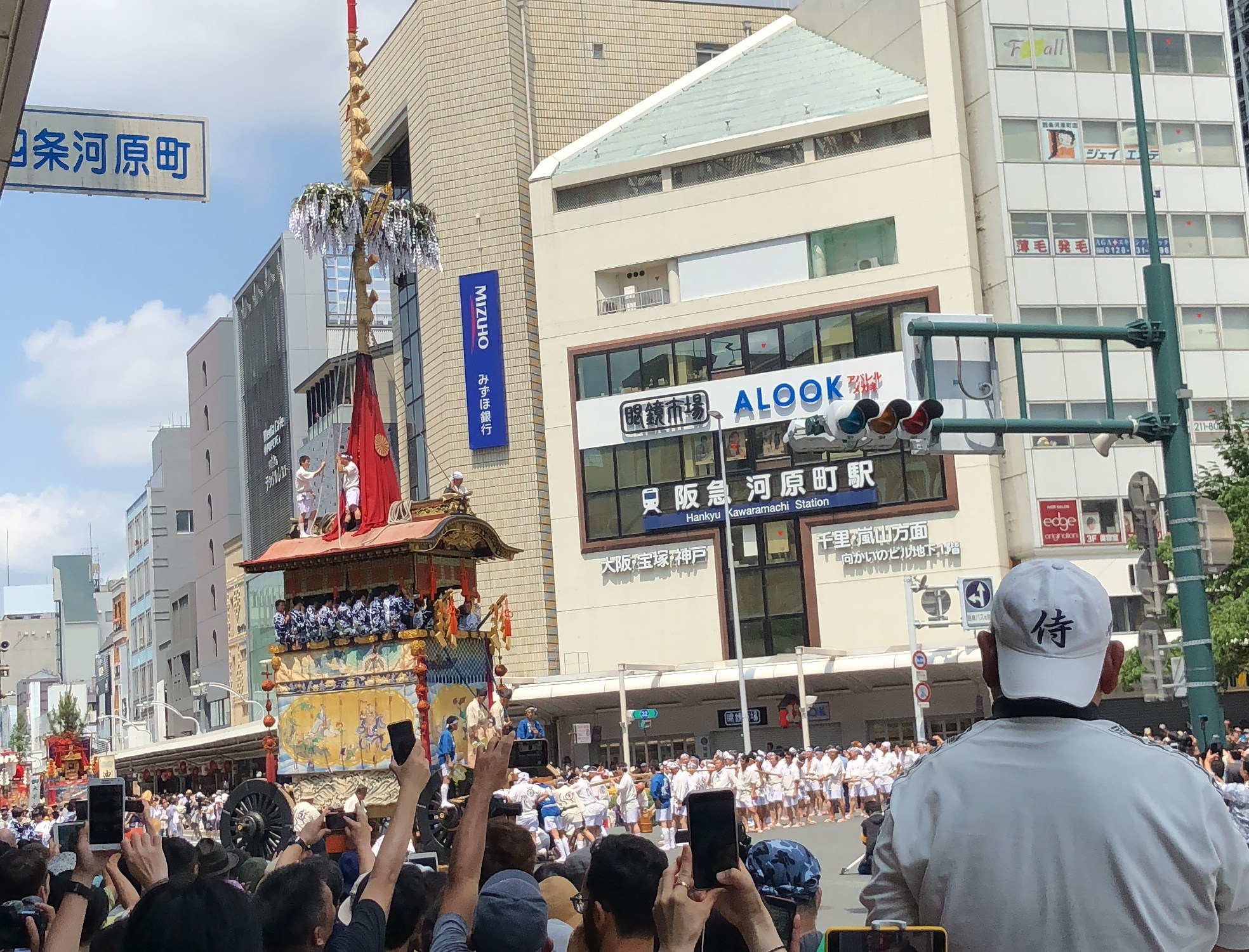
The most notable of these events is the parade on July 17th, as 23 of the floats (two-thirds of the 23 Yama and 9 Hoko) are paraded along a 3KM route. At Fuyacho street, the Naginata-hoko Chigo (sacred child) cuts a sacred rope, ceremonially beginning the procession. From Shijo-Karasuma (Shijo station), turns north at Kawaramachi station continuing down Kawaramachi-dori street turns west at Kyoto City Hall, and finishes just past Karasuma-Oike-dori street, making three large public turns called tsujimawashi. Some paid seating available in front of City Hall ¥3180 (advance booking required), online purchase in English through Voyagin for ¥4000. As the procession takes place over a lengthy route and duration, there are many good (free) viewpoints, but be aware of the time they may pass through and be prepared to crowd with other locals and visitors.
We stood on Shijo-Kawaramachi, right outside Teramachi department store, and with some leaning and tiptoeing was able to see some of the procession. This spot is particularly appealing because the large wheels of the Hoko do not have any turn and require the strength of many men and ropes, sticks, levers and lubricant to make the big turns, tsujimawashi. Combining the elaborately decorated and art-draped floats, traditional costumes, musicians and performers, with massive strength and coordination required to move these floats contrasted against the modern buildings and skyline of Shijo-Kawaramachi intersection, it’s such a spectacular view that I am so excited to be a part of this year!
At 16:00, Shinko-sai Festival
At 18:00, Mikoshi Procession, transfer ceremony.
Starting at Yasaka-jinja shrine, the shrine’s deity is carried out of shrine grounds and through the town and transferred to their temporary shrine (Otabisho) on Shijo-dori street on three Omikoshi (portable shrines) set on wooden beams and carried on the shoulders of local men.
They procession through shrines local district known as “Omikossan”, lively and popular with the locals.
We were lucky to be just outside Otabisho and was able to view the end point of the procession as many local men carried the mikoshi and did the little dance before receiving a blessing(?) and parking the mikoshi.
On July 17th 18:00, the procession of mikoshi takes place. Starting at Yasaka Shrine and ending at Otabisho, the shrine’s deity is carried out of the shrine grounds and through the town in a mikoshi, a portable shrine set on wooden beams and carried on the shoulders of local men.
On July 17th to 23rd, Silent Prayer at the Mikoshis’ Temporary Shrine
It is said that those who travel to these locations and pray silently for seven days will have their wishes granted.
On July 18th to 21st, Ato-Matsuri (Latter Festival) Yamaboko Float construction
On July 20th to 21st, Ato Matsuri (Latter Festival) Yamahoko Float-Pulling Trials *Festivities held on the 21st are observation only.
On July 21st, 22nd, 23rd, 18:00 ~ 23:00, Ato Matsuri (Latter-Festival)Yoiyama
yoiyoiyoiyama (宵々々山) on July 21, and
yoiyoiyama (宵々山) on July 22, and
yoiyama (宵山) on July 23.
Similar festivities to the Saki-Matsuri (Pre-Festival) leading up to the parade on July 24th, albeit on a smaller scale and with fewer road closures and stands.
Byobu, or Folding Screen Festivals
On July 23rd 09:00, Sencha Kencha Tea Festival at Yasaka Jinja Shrine,
Tea ceremony services will be provided by the head of a Kyoto Sencha (Japanese tea) school.
At 13:00, Biwa (Japanese lute) Performance at Yasaka Jinja Shrine,
On July 24th 09:30 ~ 11:50, Yamahoko Float Procession (山鉾巡行 Yamaboko Junko), Ato Matsuri (Post Festival procession)
The procession of the remaining 10 Yamaboko floats along a 3KM long route starting at Karasuma-Oike, continuing to Kawaramachi-dori street, back to Shijo-dori street.
At 10:00, Hanagasa Junkō 花傘巡行 (Flower Umbrella Procession), 10 colorful umbrella floats beginning from Yasaka Jinja Shrine, accompanied by 1000 people, mostly women, including geiko and maiko. It crosses the Kamogawa river and makes a loop past Kyoto City Hall, and back to Yasaka Jinja Shrine where various dances are performed, culminating in a final series of dance performances done as offerings to the gods at Yasaka Shrine.
At 17:00, Kanko-sai Festival. The three mikoshi (portable shrines) temporarily kept on Otabisho on Shijo-dori Street will begin their return to Yasaka-jinja shrine in a procession traveling throughout the shrine’s district.
On July 25th 13:00, Kyogen and Noh at Yasaka Jinja Shrine Noh Theater,
A performance will be given by the Shigeyama Noh Theater Troupe.
On July 28th 20:30, Mikoshi Purification Ceremony at Shijo Ohashi Bridge,
As on the purification ceremony held on the 10th, once the mikoshi portable shrines have been purified, they will be placed into storage.
On July 29th 16:00, Festival Summation at Yasaka Jinja Shrine,
The end of the Gion Matsuri Festival will be announced before the deity of the Shinto shrine.
On July (30?) 31st 10:00, Summer purification ritual, Nagoshisai Festival at Eki Shrine, a sub-shrine of Yasaka Shrine
A sacred reed ring will be set up at the torii gate to Eki Jinja Shrine, within the grounds of Yasaka Jinja Shrine. Members involved in the Gion Matsuri’s organization and floats gather to receive blessings from the priest and pass through the sacred reed ring to ward off misfortune. Afterwards, the public is able to pass through as well.
Saki Matsuri (23 floats)
Abura Tenjin Yama 油天神山
Arare Tenjin Yama 霰天神山
Ashikari Yama 芦刈山
Ayagasa Boko 綾傘鉾
Fune Boko 船鉾
Hakuga Yama 伯牙山
Hakuraku Ten Yama 白楽天山
Hōka Boko 放下鉾
Hoshō Yama 保昌山
Iwato Yama 岩戸山
Kakkyō Yama 郭巨山
Kankō Boko 函谷鉾
Kikusui Boko 菊水鉾
Mōsō Yama 孟宗山
Naginata Boko 長刀鉾
Niwatori Boko 鶏鉾
Shijō Kasa Boko 四条傘鉾
Taishi Yama 太子山
Tokusa Yama 木賊山
Tōrō Yama 蟷螂山
Tsuki Boko 月鉾
Urade Yama 占出山
Yamabushi Yama 山伏山
Ato Matsuri (10)
Ennogyōja Yama 役行者山
Hachiman Yama 八幡山
Hashi Benkei Yama 橋弁慶山
Jōmyō Yama 浄妙山
Kita Kannon Yama 北観音山
Koi Yama 鯉山
Kuronushi Yama 黒主山
Minami Kannon Yama 南観音山
Ōfune Boko 大船鉾
Suzuka Yama 鈴鹿山
 Hi!da
Hi!da 