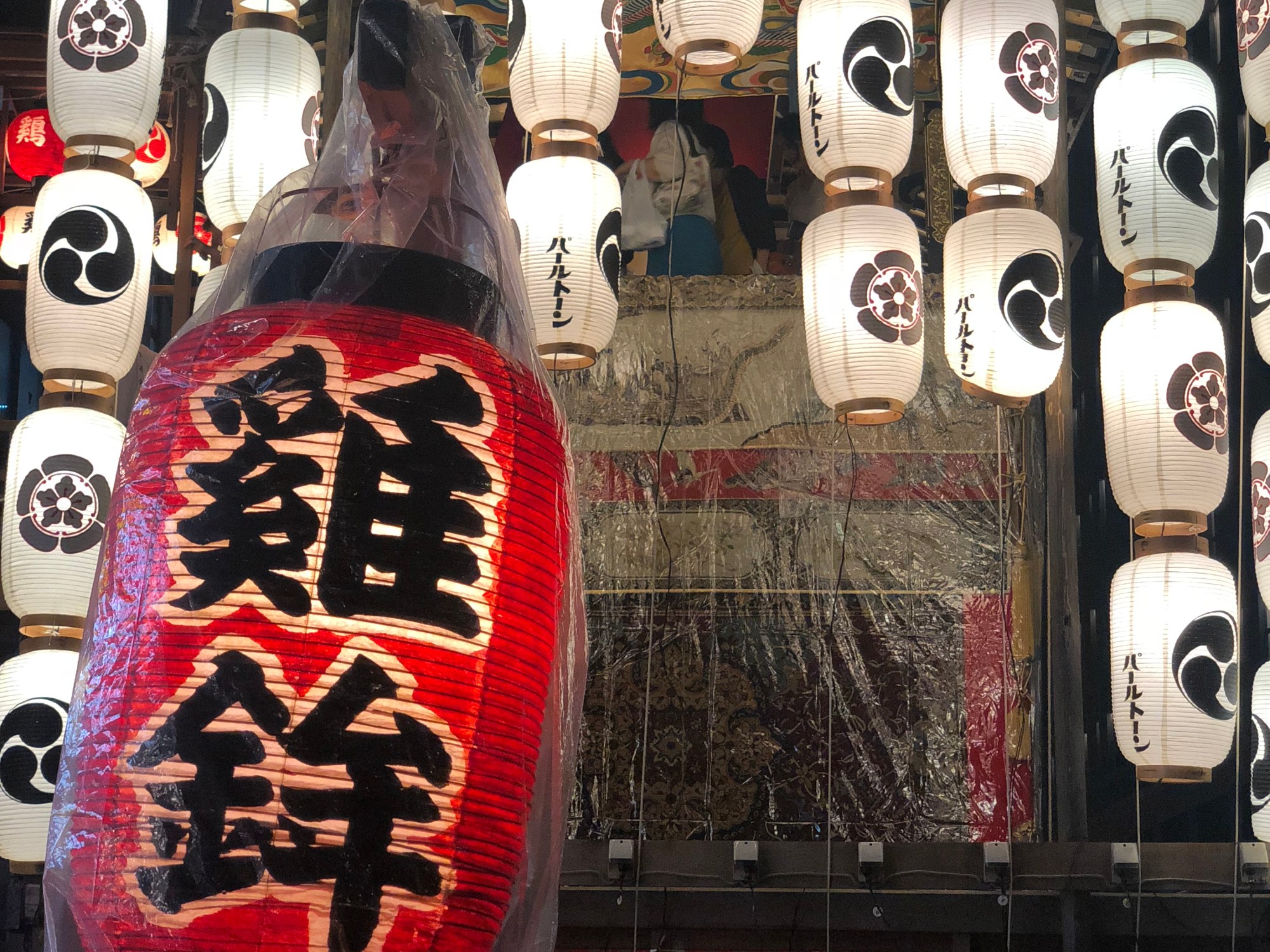
Niwatori-hoko 鶏鉾
This float derives its name from a famous tale that took place in ancient China when the legendary Emperor Yao was in power. During this time the entire country was so well governed that drums, which were meant to be hit when a complaint was made against the leaders, became coated with moss and nested by hens because they never had to be used. Thus, this float symbolizes prevailing peace in the world.
The golden circle in the triangle reportedly symbolizes an egg in a drum, from which the name “Niwatori-hoko” (literally “Hen Float”) is derived.
The rear hanging on this float is a famous tapestry, which according to a recent research shows the Trojan prince Hector bidding farewell to his wide and child. This tapestry is thought to have been made in the 16th century in Belgium and imported to Japan early in the 17th century, and is designated as an Important Cultural Asset of Japan.
 Hi!da
Hi!da 