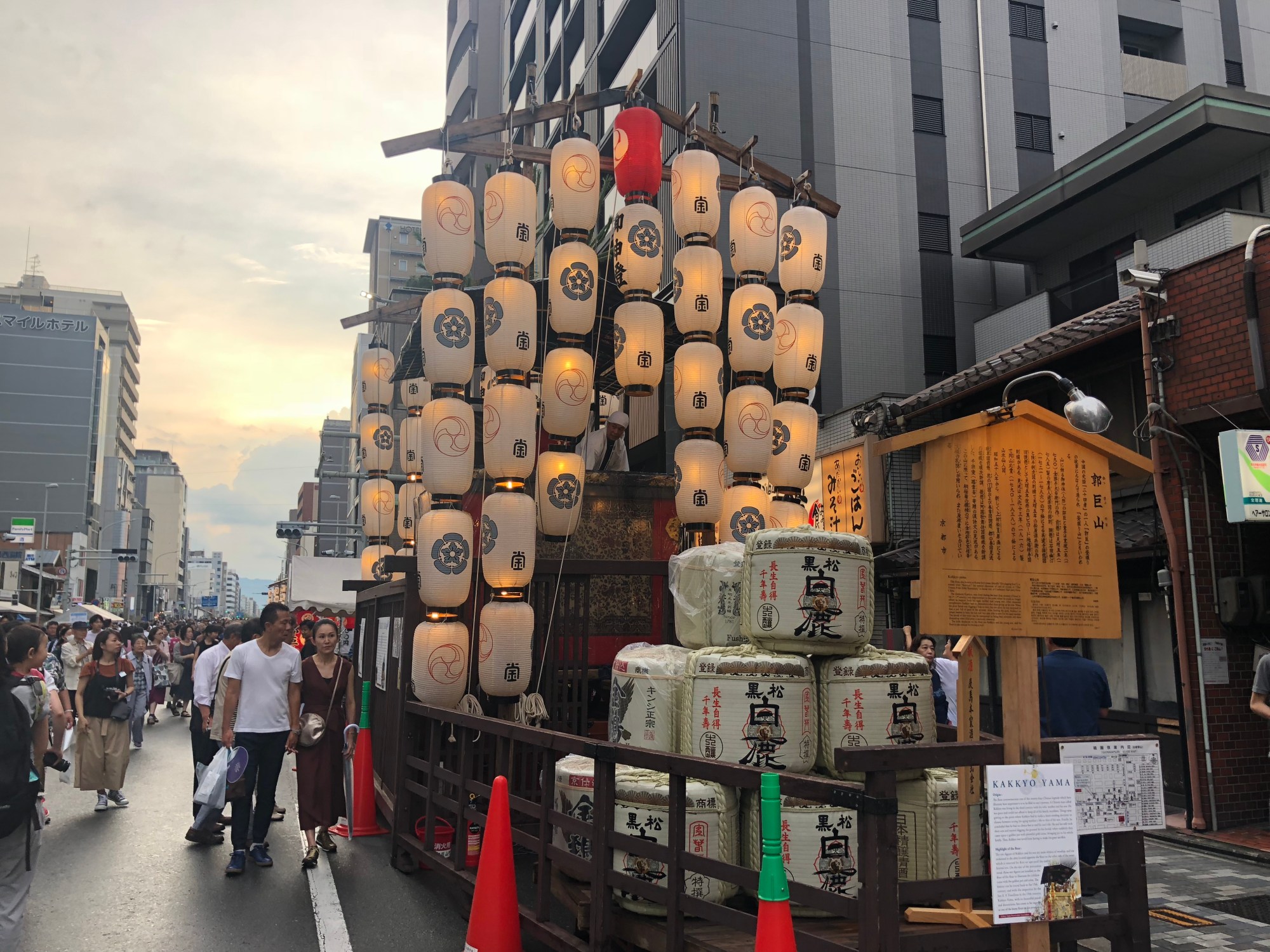
Kakkyo-yama 郭巨山 (かっきょやま)
This float, also known as Kama-hori-yama (literally “Pot-digging float”), is named after “Kakkyo”, the central character of one of the stories of “The Twenty-Four Filial Exemplars,” a classic text of Confucian filial piety from China.
The character Kakkyo, who lived during the later Han dynasty (China) in the 1st – 3rd century, was impoverished to the point where he could no longer afford to support both his aged mother and young son. After desperate consideration Kakkyo had no alternative than giving up his son. When the poor father was digging a hole to bury his son alive, he was surprised to find a pot full of gold in the ground. After finding the gold, Kakkyo no longer needed to bury his son and was also able to care for his aged mother. The moral of this story can be interpreted as being that solutions will show themselves when filial piety is seriously observed.
The dolls displayed on the float are Kakkyo and his young son, and the float is also unique for having a roof.
—
The float commemorates one of the twenty-four Chinese legends which best illustrates how important it is to be filial to one’s parents. A Chinese man called Kakkyo was living in the third century with his wife, mother and his son. He was poor and could not afford to keep all of his family members. Things were getting to the point where Kakkyo had to make a heart-rending decision: to choose between saving his aging mother’s life or that of his son. Finally, he concluded that he had no choice but to end his son’s life. He and his wife took their son and started digging the ground for his burial, when suddenly they came upon a golden pot when plentiful gold coins, bringing joy to his whole family. Thus, Kakkyo was saved from having to make his great sacrifice.
Highlights of the float
The two figures of Kakkyo and his son are the main objects of worship, and are enshrined in the altar located opposite the float on the other side of the street which is reserved for float set ups until the end of the festival eve. On the day of the procession ritual, those two figures are installed on the floor of the float to illustrate the jubilant scene with the golden pot and coins. The history can be traced back to the 15th century, and with the inspection by the late E. F. Fenollosa in the 19th century, Kakkyo Yama, with its beautiful panels and decorations, has come to be regarded as one of the finest floats in the procession.
Chimaki
Chimaki, a talisman against evil such as sickness, natural disasters, accidents, etc. Chimaki offered here at Kakkyo Yama especially is believed to have the additional power to make the household rich.
Origin: Chimaki originated from the folklore of a legendary person, Somin Shorai, who saved a traveler who was in need of overnight accommodation. The traveler in fact was a deity, and in return for the hospitality shown, gave the poor man a wreath made of reeds to protect him from a nationwide plague. The deity is said to have been Susanoo-no-mikoto who is enshrined in the Yasaka Jinja Shinto shrine. Thus the origin of chimaki. Today, it is offered with the words “we are the descendants of Somin Shorai.”
How to use Chimaki
Hung above the doorway of individual houses for a year, to be timed from the next Gion Matsuri festival, chimaki is intended to be replaced with a new one upon returning the old one to the original float, or to the Yasaka Jinja Shinto Shrine.
 Hi!da
Hi!da 